Greek Palaeography Course
Texts, Manuscripts, Editions:
Greek Palaeography, the Transmission of Texts, and Textual Criticism
2027 spring-term (January through April) Hybrid, non-credit seminar
Hosted by the Gennadius Library with the generous support of Dumbarton Oaks
Application deadline: October 31, 2026
Course Description
This course offers an introduction to Greek manuscript culture from the fourth through the sixteenth centuries CE. Students gain training in the study of Greek book scripts from Late Antiquity to the Renaissance, the transmission history of classical, post-classical, early Christian, patristic, and Byzantine literature, and the theories and techniques of textual criticism. Unlike the Gennadius Medieval Greek Summer Session, which includes a rudimentary introduction to Greek palaeography, this seminar provides comprehensive, specialized instruction in reading and dating diverse scripts, analyzing textual transmission, and preparing critical editions of ancient, medieval, and early modern Greek texts.
Format
The course will be taught by Stratis Papaioannou (University of Oxford). It will be conducted in eight 2-hour online sessions scheduled from January 19, 2027, through March 16, 2027 (Tuesdays, 7:30–9:30 pm Athens time / 12:30–2:30 pm US Eastern Time / 6:30–8:30 pm Central European Time), followed by five days of in situ instruction in Greece from April 5 to April 9, 2027 (with arrival on Sunday, April 4 and departure on Saturday, April 10).
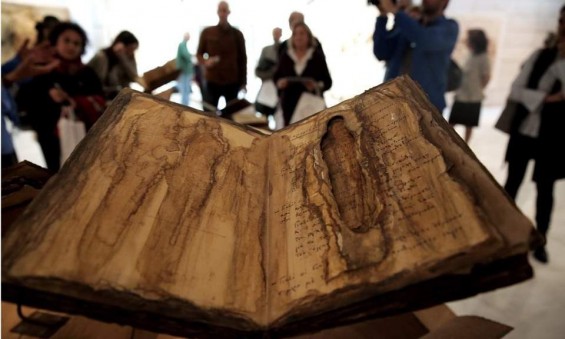
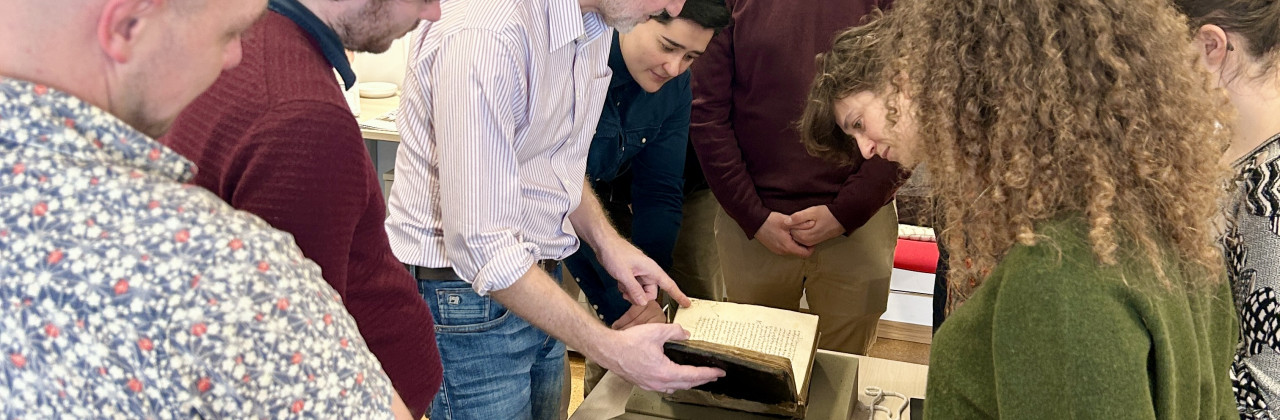
The in-person week will be conducted mainly at the Gennadius Library at the American School of Classical Studies at Athens and, during an overnight trip, at the Meteora Monasteries (Thessaly), where students will have the opportunity to examine many original Greek manuscripts hands-on. Alongside its spectacular collections in subjects related to Greek history from antiquity to the present day, the Gennadius houses one of the best collections of early printed Greek books as well as a notable collection of Byzantine and post-Byzantine manuscripts for students to consult. The library of the Great Meteoron Monastery, with more than 700 holdings, contains several rare items, including the second-earliest dated manuscript in minuscule.
Requirements for successful participation
Class attendance and the completion of weekly assigned manuscript readings. Participants will also deliver a 20-minute oral presentation (scheduled for the last two days of the Athens visit) on the textual transmission of a Greek author or text from the Roman or Byzantine period (ca. 100–1500 CE), with a focus on the history and contents of one medieval manuscript. A final take-home exam will evaluate skills in script and text identification, transcription, and textual editing.
Eligibility
Graduate students and recent Ph.D. holders (Ph.D. earned within the last five years) specializing on any relevant subject (Classics, History, Art History, Archaeology, Religious Studies, Biblical Studies, Renaissance Studies, Comparative Literature, etc.). Open to all nationalities. There is no need to have taken the Gennadius Medieval Greek Summer Session to apply for this course. A minimum of two years of college-level or graduate-level Classical Greek, or the equivalent, is required. A maximum of 10 program participants will be accepted.
Academic Credit
The American School is not a degree-granting institution. No grades are given for its programs, nor are transcripts provided. The course will be non-credit, although a certificate of successful completion shall be provided.
Costs and Scholarships
There is no tuition fee for the program, as all admitted participants will be provided scholarships with the generous support of Dumbarton Oaks.
Admitted participants with scholarships will be provided funds that shall cover travel expenses (to and from Athens) and accommodations during their week in Greece. Lunches will be provided for all participants (free of charge) in Loring Hall. Scholarships shall also cover travel expenses related to the trip to Meteora (bus, overnight hotel stay, and lunch).
Funding from the ‘The Diocesan Academy of Theological and Historical Studies of the Holy Meteora’ covers expenses related to the trip to Meteora.
Online Application
Applicants must submit: (1) A curriculum vitae; (2) A one-page statement outlining: (a) your current background in Classical and/or Medieval Greek, Byzantine culture and literature, and Greek palaeography—including your reading fluency in modern foreign languages; and (b) your future plans and how this program aligns with them; (3) Scans of graduate transcripts (undergraduate transcripts are not required); transcripts may be submitted in their original language without English translation, provided they are in the Latin or Greek alphabet; (4) Email addresses for two references (including your academic advisor) who are familiar with your academic work and willing to provide letters of recommendation.
Note about recommendations: Recommendations are due on the same date as the deadline for applications. Upon submission of the online application, recommenders will be sent an automated email with instructions about how to submit their letters of recommendation. Or, an applicant may choose to send the request at any time by clicking the "Send Request Now" button on the online application form. It is preferable for recommendations to be submitted in English.
Application deadline: October 31, 2026
Apply NowSponsor Acknowledgment
This program is generously funded by Dumbarton Oaks, whose comprehensive support makes the seminar possible. Grateful acknowledgment is also extended to The Diocesan Academy of Theological and Historical Studies of the Holy Meteora for hosting and providing hospitality during the overnight trip to Meteora
For more information contact: