Hesperia 95.2 Now Online!
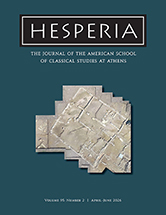
We are pleased to announce the publication of Hesperia 95.2! Topics in this issue include the iconography of Aristogeiton, a Classical-period house at Molyvoti in Thrace, the aftermath of earthquakes in 2nd-century CE Lycia, and painted interior columns from an Ottoman-period church in Palamas, Thessaly.
Subscribers can read the issue online at Project MUSE, which now hosts current issues of Hesperia as well as an archive of past volumes dating to 2002. Hesperia remains on JSTOR as part of their Arts and Sciences II package, with the usual three-year moving wall. Additionally, all issues of Hesperia from 2011 and earlier are available as Open Access on our website. The printed version will be mailed shortly.
What Makes an Aristogeiton? by Martha C. Taylor, details how scholars have identified many allusions to the Tyrannicides monument of Kritios and Nesiotes in vase painting. She argues, however, that many of these proposed allusions cannot stand—not only because the “Harmodios blow” predates the Tyrannicides but also because scholars’ identifications of “Aristogeiton” allow many discrepancies from the original figure and ignore his most distinctive attribute, a scabbard. Attention to this attribute reveals a series of vase paintings, originating before the creation of the Tyrannicides statue group, in which a scabbard-bearing hero pursues a perfidious woman, womanly man, or female animal. Aristogeiton may be understood to belong in this group: his scabbard puts the absent Hipparchos in the place of a woman or unmanly man and reasserts the masculinity of Harmodios and Aristogeiton—and through them, that of all free Athenian males.
A Classical House in Aegean Thrace and Its Hinterland: The Molyvoti, Thrace, Archaeological Project, 2019 and 2022 Preliminary Report, by Nathan T. Arrington, Domna Terzopoulou, Marina Tasaklaki, Georgios Makris, Nicholas Hudson, Chantel White, Demetrios Brellas, Elena Cuijpers, Mattia D’Acri, Ioannis Bellas, Mark L. Lawall, and Annareta Touloumtzidou, presents the second campaign of the Molyvoti, Thrace, Archaeological Project (MTAP), which focused in 2019 and 2022 on the House of Hermes, a 4th-century BCE structure, and its hinterland. A discussion of the architecture, a representative sample of artifacts, and a preliminary presentation of plant and animal remains illustrate the organization of the house, the activities that occurred within it, and its place in regional networks. From the post-Classical periods, Roman ceramics illuminate trends in the circulation of wares in the Aegean. Pedestrian surface survey noted an absence of Roman material away from the coast, while detecting Late Byzantine and Ottoman predecessors to modern villages.
Coping with Catastrophes: Earthquakes, Benefactors, and Archiereis in Lycia in the Early 2nd Century CE, by Andrew Lepke, examines the evidence for seismic activity in Lycia during the early 2nd century CE. By comparing a hitherto neglected passage in the Chronographia of John Malalas with the epigraphic evidence from Patara and other Lycian cities, it reevaluates the chronology of major earthquakes in Lycia and suggests that a destructive event in 115 CE preceded the catastrophe of 141/2 CE. Using recently published inscriptions and a new text presented here for the first time, the study sheds light on the way in which natural disasters influenced urban development, and on the role played by civic benefactors in the region’s recovery.
The Printed Page and the Painted Column: An Architectural Microhistory of a Church in Ottoman Thessaly, by Nikos Magouliotis, details how in the 18th and 19th centuries, craftspeople in the Ottoman world encountered Western-style ornament through books printed in Vienna and Venice that circulated throughout the Balkans. Although they were not intended as pattern books, these prints often served as sources for iconographic and ornamental motifs for the painted decoration of buildings, leading to the dissemination of Western Baroque motifs even into remote and rural areas. This article relates this phenomenon to the church of Ayios Athanasios in Palamas, Thessaly (built 1810–1811), examining how a group of painters decorated its interior with motifs copied from liturgical books produced in Venice. The result was a regional artistic idiom that transcended the limits of modern scholarly designations such as “folk art” and “post-Byzantine.”
Click here to subscribe to Hesperia. In addition to receiving printed issues and online access to Hesperia, subscribers also receive complimentary online access to Hesperia Supplements, and Agora and Corinth volumes.
Hesperia welcomes submissions from scholars working on all aspects of Greek material culture, including archaeology, art, architecture, history, epigraphy, and related studies. Further information about the journal, including instructions for preparing manuscripts for submission, can be found on our website.
The Friends of Hesperia was founded in 2014 to help fund the journal's growth in all its manifestations. We invite you to become a member today and help support one of the most preeminent journals in the field of Mediterranean archaeology.