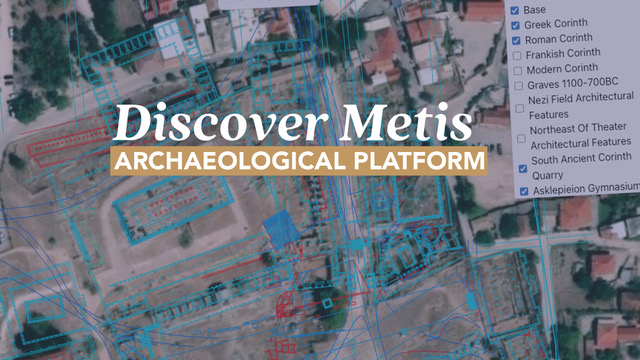
Discover Metis
What can 130 years of excavation tell us about one of the ancient world's most centrally located, interconnected, and continuously occupied sites?
Metis, the new online archaeology platform of the Corinth Excavations, American School of Classical Studies at Athens (ASCSA), can help answer that question.
With over 670,000 records spanning from 1896 to the present day, Metis brings together finds, stratigraphic contexts, field records, photographs, drawings, and artifact and coin indices in a single searchable resource. Many of the records are georeferenced to the excavation's GIS base plan. The digital archive holds excavation notebooks, artifact and coin index cards, photographs ranging from large-format glass negatives to contemporary digital images, and field records representing the full sweep of habitation from the Neolithic through the Modern period.
The platform is designed to support researchers, students, educators, and local and global enthusiasts. It promotes scholarly inquiry across a wide range of disciplines — from archaeology and ancient history to numismatics, bioarchaeology, anthropology, archaeological sciences, Byzantine studies, and the history of modern Greece. Of the platform's 670,000 records, 508,000 are freely accessible to the public at metis.ascsa.edu.gr. A further 162,000 are available to credentialed researchers.
The depth of the archives reflects two decades of digitization made possible through EU and Greek State funding initiatives, including the 2007 "Information Society" Operational Program and the recent NSRF 2020–2027 "Digital Transformation" project. In addition, Kress Funding helped digitize the Coin Study Collection. The original Corinth platform on ascsa.net was designed by Bruce Hartzler. The current platform has been developed by Tarek Elemam, Elpida Pertesi, Stelios Manousopoulos, and James Herbst, with much helpful advice from Chris Pfaff, Ioulia Tzonou, Manolis Papadakis, Bonna Wescoat, and many others.
We welcome inquiries from researchers whose work intersects with Corinth's remarkably rich history and invite the wider scholarly community to explore the archive and share their feedback as the platform continues to grow.